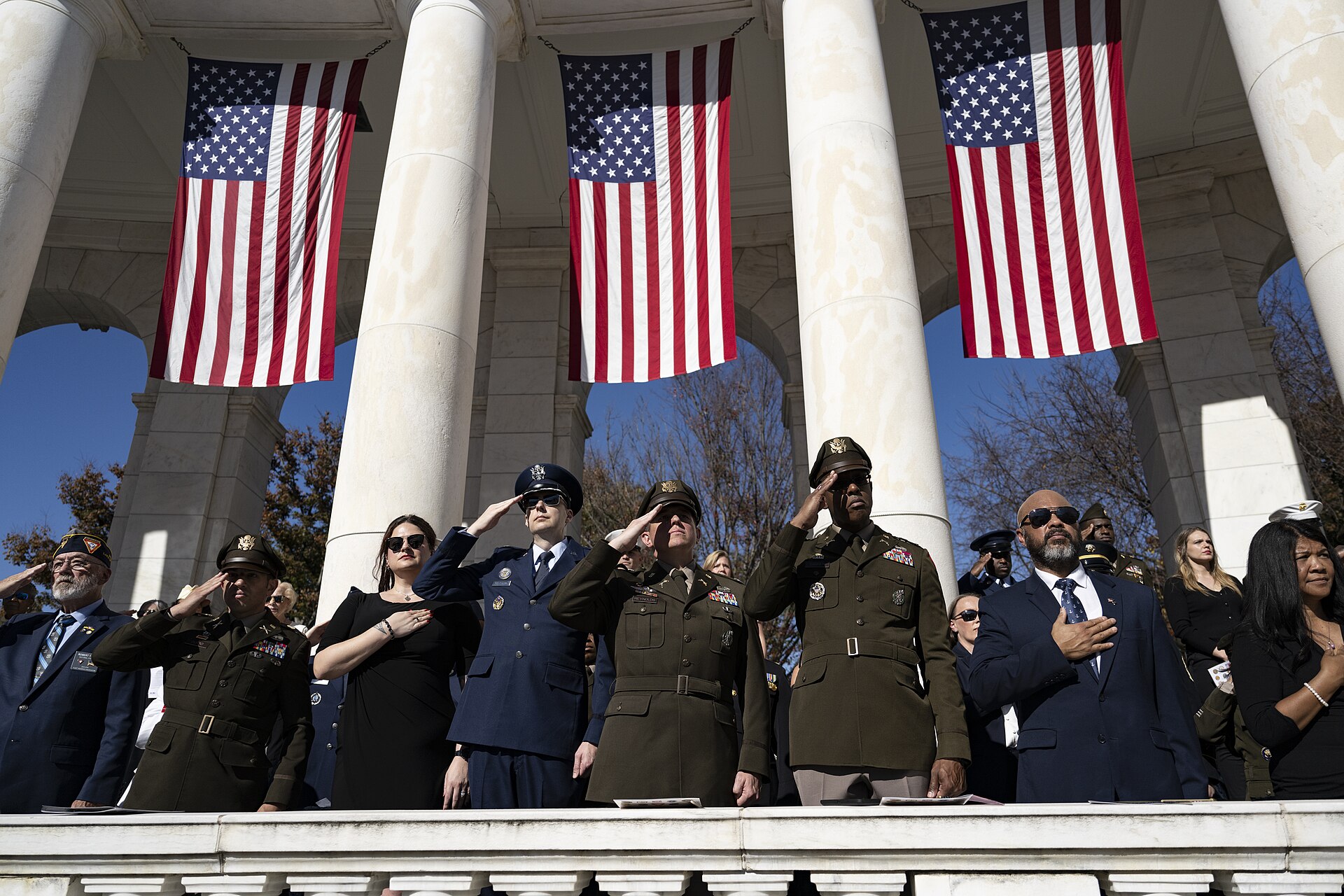
Every November 11, the United States observes Veterans Day, a federal holiday honoring people who have served in the U.S. armed forces. The date was not chosen at random. It traces directly to the end of fighting on the Western Front in World War I, when an armistice took effect at 11 a.m. on November 11, 1918—the eleventh hour of the eleventh day of the eleventh month.
Veterans Day began as a commemoration of that armistice and eventually broadened to recognize American veterans of all wars. Its history also explains why it is different from Memorial Day, why the observance briefly moved to October, and why the date returned to November 11.
1918: an armistice, not a final peace treaty
World War I devastated much of Europe and involved countries across the world. On November 11, 1918, an armistice between the Allied powers and Germany ended major hostilities on the Western Front. An armistice is an agreement to stop fighting; it is not necessarily the same thing as a final peace treaty. The Treaty of Versailles was signed the following year, in 1919.
For civilians and soldiers, the cessation of fighting was a profound turning point. Crowds celebrated in cities across the United States and abroad. But the end of combat did not erase the enormous human losses, disabilities, grief, or political consequences of the war.


How Armistice Day began in the United States
President Woodrow Wilson proclaimed the first Armistice Day observance in 1919. Early commemorations emphasized gratitude, reflection, and the hope of lasting peace after the Great War. The federal government recognized November 11 as a legal holiday in 1938, when Congress established Armistice Day to honor veterans of World War I and the cause of world peace.
The name made sense in the years immediately following that conflict. Yet American service did not end in 1918. World War II and the Korean War brought new generations of veterans and prompted discussion of whether a holiday focused on one war should honor all who had served.
1954: Armistice Day becomes Veterans Day
In 1954, Congress amended the 1938 law by replacing “Armistice” with “Veterans.” President Dwight D. Eisenhower signed the legislation on June 1, 1954. The holiday’s expanded purpose was to honor American veterans of all wars rather than only the generation associated with World War I.
That change matters because the holiday is not solely a celebration of military victories or a remembrance of those who died. It is also an acknowledgment of living veterans, their service, and the continuing consequences of military life.
Why the date briefly moved to October
The Uniform Monday Holiday Act, enacted in 1968, moved several federal holiday observances to Mondays. Veterans Day was among them, with the first Monday-observed Veterans Day falling on October 25, 1971. The change generated objections from veterans’ organizations and others who believed November 11 carried unique historical meaning.
Congress later restored the fixed November 11 date. President Gerald Ford signed the change in 1975, and it took effect in 1978. Veterans Day has remained associated with November 11 regardless of the day of the week, although federal employee holiday-observance rules can shift the day off when the date falls on a weekend.
What happens at Arlington National Cemetery?
One of the most recognizable national observances takes place at the Tomb of the Unknown Soldier in Arlington National Cemetery. Ceremonies include the laying of a wreath and other honors, reflecting remembrance and respect for service. The Tomb honors unidentified American service members; its symbolism is broader than any single conflict.


Local observances can look different: parades, school assemblies, visits to veterans’ facilities, and community events. None of these requires a particular political view about current wars. The holiday’s stated purpose is recognition of service.
Veterans Day versus Memorial Day
Veterans Day honors all American military veterans, living and deceased. Memorial Day, observed on the last Monday in May, specifically honors U.S. service members who died in military service. The two holidays overlap in respect for military sacrifice but have different primary emphases.
Armed Forces Day, observed in May, is another distinct occasion, recognizing those currently serving. Distinguishing the holidays helps keep their history and purposes clear.
Does the holiday mean everyone agrees about war?
No. Americans can disagree strongly about military interventions, national-security policy, budgets, and foreign alliances while recognizing the service of veterans. Historical explanation of Veterans Day does not imply support for or opposition to a particular conflict. The holiday has been observed under administrations and political coalitions with very different defense policies.
For No Step On Snek’s separate policy positions, readers can consult its foreign policy and defense page. This article is a nonpartisan history of the holiday, not an endorsement of that platform.
Why November 11 still matters
The original armistice gave November 11 a meaning that survived the shift from a World War I remembrance to a broader national observance. The fixed date ties present-day recognition to a documented historical event while making room for veterans of later generations.
Remembering that history also prevents common errors: the armistice was not the Treaty of Versailles; Veterans Day was not always called Veterans Day; and it is not interchangeable with Memorial Day. Those distinctions make the holiday’s significance more precise rather than less meaningful.
Sources and further reading
- U.S. Department of Veterans Affairs — History of Veterans Day
- U.S. Department of Veterans Affairs — Veterans Day
- U.S. Army — Tomb of the Unknown Soldier
- Congress.gov — Veterans Day legal history
- U.S. Office of Personnel Management — Federal Holidays
Editorial disclosure: This educational article was prepared with AI assistance using the cited government and archival sources. It is not firsthand reporting or an endorsement of the site’s policy positions. Owner review is required before publication.